
Denver
Denver is a city and county in the central north of Colorado, the United States. It is located almost midway between Chicago and San Francisco, at the eastern foot of the Rocky Mountains in western Turkey. It is the capital of Colorado and is not only the center of politics, economics and culture, but also the center of the region called the Front Range Urban Corridor. The population is 600,158 (according to the 2010 census), the largest city in Colorado and the 26th largest city in the U.S. after Phoenix in the mountainous region, and the second largest in the U.S. after El Paso in the county and the second in the state in the U.S., which is larger than the population of the entire Wyoming state adjacent to the north of Colorado. The population of the metropolitan area covering 10 counties, centering on Denver City, is 2,543,482, and the population of the metropolitan area, including Boulder and Grily Metropolitan Area, is 3,090,874 (all of which are census surveys conducted in 2010).
| Denver County City and County of Denver | |||||
|---|---|---|---|---|---|
| |||||
| Nickname: The Mile-High City, Queen City of the Plains | |||||
| Position | |||||
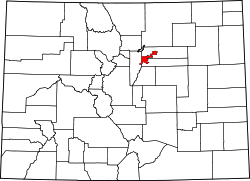 the location and city of Denver in Colorado | |||||
| Position | |||||
 Denver Denver, Colorado Denver Denver, United States | |||||
| Coordinates: 39 degrees, 44 minutes, 21 seconds north latitude and 104 degrees, 59 minutes, 5 seconds west longitude/39.73917 degrees north latitude and 104.98472 degrees west longitude/ 39.73917 degrees; -104.98472 | |||||
| History | |||||
| establishment | November 17, 1858 | ||||
| administration | |||||
| country | |||||
| State | Colorado | ||||
| City County | Denver County | ||||
| mayor | Michael Hancock | ||||
| geography | |||||
| area | |||||
| city-county area | 401.3 km2 (154.9 mi2) | ||||
| land | 397.2 km2 (153.3 mi2) | ||||
| water surface | 4.1 km2 (1.6 mi2) | ||||
| urban area | 21,621 km2 (8,346 mi2) | ||||
| Elevation | 1,609 m (5,280 ft) | ||||
| population | |||||
| population | (as of 2010) | ||||
| city-county area | 600,158 | ||||
| population density | 1,511.0 people/km2 (3,914.9 people/mi2) | ||||
| urban area | 2,543,482 | ||||
| Remarks | 26th largest population of U.S. cities | ||||
| Other | |||||
| equal time | Mountain Standard Time (UTC-7) | ||||
| daylight saving time | Mountain Daylight Time (UTC-6) | ||||
| Official website: https://www.denvergov.org/ | |||||

Denver began in the middle of the 19th century in a remote mining town that was established during the Gold Rush. When the carriages and the railroads were opened, Denver developed as a hub of transportation and distribution. After the latter half of the 20th century, the development of large-scale high-tech corporate housing complexes in the southern part of the city and the geographical conditions of upland also developed the communication industry.
Officially, Denver is said to be one mile (5,280 feet per 1,609m) above sea level, and is called Mile High City (a town one mile above sea level). The steps and seats that are '1 mile above sea level' are distinguished at the front entrance steps and Coors Field of the Colorado State Capitol. There are also many examples of Empowerfield at Mile High that have the name "Mile High." The magazine and company name of "5280", one of the local magazines, is also named after the Denver Elevation of "5,280 feet."
History
At the eastern foot of the Rocky Mountains, where Denver is today, on the western edge of the Great Plains, various native American tribes were scattered there before the European settlement began. In the 16th and 17th centuries, mainly the Uths and the Apache people lived there. In the first half of the 19th century, the Cheyans and the Arapaho were over winter there.
In the summer of 1858, during the Pikes Peak Gold Rush, gold explorers from Lawrence, Kansas Territory, built a mining town called Montana City here along the South Platte River in the western part of the territory. This Montana City was the oldest settlement in the area, which would later become Denver City. However, this settlement did not last long, and when mining towns such as Australia and St. Charles City were established downstream of it, it was abandoned in the summer of 1859.
On November 22, 1858, a land-specter, William Larimer Jr., who came to this place from the eastern Kansas Territory, placed a log of Phako Willow on a cliff on the other side of Australia's St. Charles Street overlooking the confluence of the Southplatte River and Cherry Creek area, in the South Platte River, in order to claim ownership of the land. Then Larimer named the town Denver City to cheer up the then Kansas Territory Governor James W. Denver. Later, a large county office of Arapaho County, Kansas Territory, which extends from the border of Kansas and Colorado today, was located in Denver City. Then, with the aim of creating a big city that would accept new settlers, Larimer sold the block of the town to merchants and minors together with the St. Charles Land Company. The site of the town, which was established in the early period, is now a Confluence Park, which stretches northwest of downtown.
At that time, Denver City was a remote town that had established a regional economy through gambling, drinking bars, livestock and commodity trades with local miners. In the early Denver City the lot was given to and bet on the Australian miners. In May 1859, the residents of Denver City donated 53 blocks of land to the Leavenworth and Pikes Peak Express in order to secure the first drive in the area. With the opening of the road, the Leavenworth and Pikes Peak Express, which shortened its twelve-day journey to Denver to six days, provided daily transportation services for passengers, letters, freight, and gold. In 1860, Australia merged with Denver City and renamed it the West Denver area.
On February 28, 1861, when the central and eastern parts of the Kansas Strip were promoted to Kansas State, the Colorado Sub-State was created in the western part of the remaining Kansas Region by integrating some of the neighboring sub-states Nebraska, Utah and New Mexico. On November 1 of the same year, Arapaho County was established as a county of the Colorado sub-state, and on November 7, Denver City was incorporated into the public. In 1867, the capital of the Colorado sub-state was moved from Golden City to Denver City. On August 1, 1876, Colorado was promoted to the state.
In the late 1860s, the inhabitants of Denver had already established a vibrant supply and service center here, proud of its success, but once the first transcontinental railroad in the history of the United States was decided to pass through a far north Sian instead of Denver, they began to care about the future of this young town. At a distance of 100 miles (160 km), the residents started a campaign to build a railroad between the cross-continent railway and Denver. Eventually, Junshu Governor John Evans and David Moffat and Walter Cheesman started raising funds. Only three days after the start, $300,000 came and the residents were optimistic. However, the leaders of Evans and other companies had no choice but to run the railway business because they were in debt and were unable to raise enough funds. Despite these difficulties, on June 24, 1870, the Denver Pacific Railway, which led to the cross-continent railway, was opened to the public with joy.
As Denver was connected to other areas in Japan by rail, it flourished as a service and supply center. The young town grew rapidly, attracting millionaires and building houses, while poverty and crime spread. The residents were proud that the millionaires had chosen Denver, and one of them was excited at the building of the Teber Grand Opera House, which was built by Redville's Silver King Horace Teyber, in a block at the corner of 16th Street and Larimer Street. Later, luxury hotels such as the Brown Palace Hotel, and millionaires' residences such as the Croque Patterson Campbell's and Moffat's were built. To transform Denver into one of the world's great cities, leaders have lured industry and assembled workers working in the factory. Soon, in addition to the elite and many middle class workers, the population of German, Italian, Chinese workers, and later African and Spanish workers increased rapidly. However, in the midst of such an inflow, the regional economic recession triggered by the silver price crash in 1893 broke the balance of local politics, society and the economy in Denver, and feud among ethnic groups increased, such as red-hunting, the rise of Ku-Klux and Klan, in addition to corruption and crime.
In Denver between 1880 and 1895, crime syndicate boss Soapy Smith was behind bars and colluded with city officials and police to control elections, gambling and gangs, and the city authorities were corrupt. However, in 1887, in order to help the poor in Denver, a local religious leader raised funds and later established a charity group that would later become United Way. According to the 1890 census, Denver had a population of 106,713, and it became the largest city in the west of Omaha, next to San Francisco.
Also, from the 1880s to 1930s, the flower and ornamental plants industry developed and flourished in Denver. This period is called Carnation Gold Rush locally
In 1901, the Colorado State Council passed a bill to divide Alapaho County into three parts: Denver City County, Adams County and South Alapaho County (now Alapaho County). In the following year, 1902, the bill passed a nationwide referendum, establishing Denver City County and revising the Constitution of the State. Two years later, in 1904, the Denver City County Charter was passed. However, the legal battle over the bill continued and it was in 1916 that the final settlement was reached.
At the beginning of the twentieth century, like other cities across the United States, there was a brass-era auto company in Denver. Korburn Motor Company was founded in 1906 and closed its business in 1911 to produce a copy car of Renault which was one of the manufacturers that was popular at that time.
During World War II, Ralph Lawrence Kerr, the governor of Colorado State in 1939-42, warmly welcomed the Japanese who had been deported from the West Coast due to deportation into Colorado. After the war, in 1947, a Tristate Denver Buddhist Temple was built in a corner of the Japanese residential area, which had been downtown in Denver since 1900. Many Japanese residential areas were lost due to the redevelopment of downtown in 1969, but only one block surrounded by 19th Street, 20th Street, Rally Street and Lawrence Street, where Buddhist temples were located, was left. In 1973, a small park called Sakura Square and a cultural center were built in the block at the east corner of 19th Street and Larimer Street. In 1976, Japanese people erected a bronze statue in a small park in Sakura Square in honor of Kaa's achievements.
Between 1953 and 1989, the Ministry of Energy's nuclear weapons production facility, located about 15 miles (24 km) in the northwest suburb of Denver, Rocky Flats, manufactured pits made of fissile material plutonium used for nuclear warheads. In addition to a massive fire that broke out in 1957 and 1969, radiation from radioactive waste was leaking rapidly from radioactive waste from 1958 to 1968. The contamination caused by plutonium 239, a radioactive substance, spread throughout the surrounding area, including a part of the Denver City area. A 1981 study by Dr. Carl Johnson, Director of Health Department, Jefferson County, showed the relationship between radiation contamination and congenital diseases and carcinogenesis in central Denver and Rocky Flats, and was supported by subsequent research. Even in the 2010s, radiation contamination by plutonium still remains around the site of the facilities, and when the facilities are completed, it has become a dangerous factor in the construction of Jefferson Parkway, which forms the west side of the Denver Loop Line.
In 1970, Denver decided to host the 1976 Winter Olympics, and if it was held as it is, it would have been held at the same time as the celebration of the 100th anniversary of the elevation of Colorado state. However, in November 1972, in addition to concerns about the impact on the natural environment, the state referendum rejected the public funding to cover the high cost of hosting the event, forcing the host to give up. Four months later, the IOC hastily moved to Innsbruck, where the Winter Olympics of 1976 had been held, and where the facilities and infrastructure for the event had been arranged, at the venue for the 1964 Winter Olympics. Later, Denver sought the possibility of running for the 2022 Winter Olympics to be held, but the United States Olympic Committee did not run for the tournament.
An estimated 500,000 people participated in the sixth World Youth Day held in Denver between August 10-15, 1993, and it became the most popular event in Colorado's history. On June 20-22, 1997, a summit was held in Denver. In 2008, the Democratic National Convention was held in Denver for the first time in 100 years since 1908 to inform the country of Denver's political and socioeconomic status.
In 1967, the Denver Historical Buildings Protection Program was launched to protect and maintain historic buildings in the city. As of 2017, the 50th anniversary of the building's founding, 326 buildings of historical buildings and 52 historical districts have been designated as such. In 2000, the Municipal Assembly adopted the Comprehensive Plan 2000, which included 11 items such as the protection of the natural environment, the effective use of land, and a sustainable local economy. In 2002, the Municipal Assembly adopted the Blueprint Denver, which included three items: a site for changing places, a site for not changing places, a street where multiple kinds of transportation means can coexist, and a multi-purpose development, as a supplement to the Comprehensive Plan 2000. And in 2010, the city and county council adopted a new zoning scheme with a view to the future of the city.

geography
Denver is located at 39 degrees 44 minutes 21 seconds north latitude and 104 degrees 59 minutes 5 seconds west longitude. The 105th Western Longitude Line, the reference line for mountain standard time, passes directly above Union Station, which stands northwest of downtown. Ichi-gun is located on the west edge of a relatively flat plateau area called the High Plains in the western part of the Great Plains, which is about 1,600km west of Chicago, the eastern foot of the Rocky Mountains. Denver also serves as the heart of the area called the Front Range City Corridor, which runs along the I-25 from the northern capital of Shian, Wyoming, to the southern capital of Pueblo.
According to the United States Census Bureau, Denver City County has a total area of 401.3km2 (154.9mi2). Of them, 397.2km2 (153.3mi2) is land and 4.1km2> (1.6mi2) is the water area. The area accounts for 1.1% of the total area. Only three counties adjacent to Denver City County are Adams County in the northeast, Arapaho County in the southeast and Jefferson County in the west. These three counties have been growing at a high rate since the late 20th century, becoming the third largest city in the state, and are crowded with large suburban cities, including Aurora, one of the best boomerang in the United States. In the southeastern part of Denver City County, there are two outposts in Alapaho County surrounded by the Denver City County, one of which is incorporated as Glendale City and the other which is not incorporated, but is designated as Holly Hills CDP. The urban area of Denver consists of 10 counties centering around Denver City County, and the area is 21,621km2(8,346mi2).
As the nickname Mile-High City indicates, the official elevation of the city is one mile (5,280 feet per 1,609m). In the front steps of the Colorado State Capitol, there is a sign that says this, which corresponds to the '1 mile above sea level,' and in the Coors Field, there is a purple-colored passenger seat, which corresponds to the '1 mile above sea level', painted in the team color of Colorado Rockies. However, the elevation of the city area actually reached 5,130-5,690 feet (1,564-1,734m).
climate
| Denver | ||||||||||||||||||||||||||||||||||||||||||||||||||||||||||||
|---|---|---|---|---|---|---|---|---|---|---|---|---|---|---|---|---|---|---|---|---|---|---|---|---|---|---|---|---|---|---|---|---|---|---|---|---|---|---|---|---|---|---|---|---|---|---|---|---|---|---|---|---|---|---|---|---|---|---|---|---|
| Rain and Temperature (Description) | ||||||||||||||||||||||||||||||||||||||||||||||||||||||||||||
| ||||||||||||||||||||||||||||||||||||||||||||||||||||||||||||
| ||||||||||||||||||||||||||||||||||||||||||||||||||||||||||||
The climate of Denver is characterized by the dry throughout the year, the hot, cool during the day, and the mild winter during the day, but the cold, hard winter during the night, and is characterized by a clear, seasonal, changeable, and mountainous climate. In the climate division of Keppen, Denver belongs to a Step Climate (BS). Generally speaking, Denver is believed to be sunny for 300 days a year, but in reality, Kaisei covers 115 days a year, Fair for 130 days a year and Cloudy (or rain or snow) covers 120 days a year.
The average hot July temperatures reached about 31°C, which means that about half of the month in average is above 32°C during the day, while the minimum temperatures dropped to an average of 15°C and the average temperature is about 23°C. The coldest December temperature is 1°C below freezing point and the average minimum temperature is 8.5°C below freezing point, so the temperature falls below freezing point almost every day, but during the day it is warmer and reaches around 6°C, depending on the altitude. The amount of rainfall is high from May to August in summer, but it is still about 50-60mm per month. From November to February in the winter season, the number of winter months is small, and it is approximately 12-20mm per month. In spring and autumn, it is about 30-40mm per month. Annual rainfall is about 390mm. The amount of snow in the month from November to April in winter reaches 15-27cm and the amount of snow in the year reaches 136cm.
Although the tornado is rarely seen in the west of the I-25 line, on June 15, 1988, the tornado with the Fujita Scale F3 tornado was hit at 7 km south of downtown. On the other hand, in the eastern suburb of Denver and the northeastern part of the city which was incorporated by the opening of the Denver International Airport, the Improved Fujita Scale EF0-1 () is popular in June when the Denver Convergence Spiral Zone (DVZ) was developed, especially from spring to summer, but it is relatively easy to develop tornado and sometimes it becomes a land tornado. DCVZ's storm has also affected the operation of Denver International Airport. Denver is also liable to hail. On May 8, 2017, the hail storm hit a densely populated area in the Denver metropolitan area during the time of commuting, bringing down the hail with a large amount of baseball and causing a large amount of damage to houses and automobiles, which amounted to a total of $1.4 billion.
| Jan | Feb | March | April | May | June | July | August | September | Oct | November | Dec | Years | |
|---|---|---|---|---|---|---|---|---|---|---|---|---|---|
| Mean Temperature (°C) | -0.6 | 0.4 | 4.4 | 8.6 | 14.0 | 19.4 | 23.1 | 21.9 | 16.9 | 10.2 | 3.7 | -1.1 | 10.1 |
| Precipitation (mm) | 12.7 | 12.7 | 33.0 | 43.2 | 58.4 | 43.2 | 53.3 | 53.3 | 27.9 | 27.9 | 20.3 | 15.2 | 396.2 |
| Snowfall (cm) | 17.8 | 14.5 | 27.2 | 17.3 | 2.8 | - | - | - | 1.3 | 10.2 | 22.1 | 21.6 | 136.7 |
urban overview
district

There are officially 78 districts in Denver City. The characteristics of these 78 districts are very different from each district, and the buildings that are built vary from the skyscraper to the house, and the houses vary from the late 19th century to the modern suburban type. Generally, the more the area is located near the center of the city, the more dense it is, and the more old it is, the more brick buildings are. Many areas far from the center were developed after the World War II, and there are many modern buildings using modern building materials and also in the architectural style. Areas farther away from the center, and areas which were redeveloped after the late twentieth century, have very suburban characteristics, or the atmosphere of the old areas is reconstructed by the development based on New Urbanism. Many areas have facilities, such as parks, that are central to local activities.
In Denver, there is no official system for a larger division of districts, such as Chicago's Side. However, Denver citizens use words such as "North," "South," "East," and "West" as a rough area. There are also some unofficial district names given by real estate developers, such as 'LoDo' (for lower downtown), which refers to a part of the Union Station area, and 'uptown', which extends from the North Capital Hill area to the City Park West area.
street
Most of the streets in Denver City County run east-west or north-south, and they are neatly divided like a grid board. The street running east-west is called 'Avenue,' and it is divided into the east (E) and west (W) on the Broadway that runs through the east end of downtown. On the other hand, the street running north-south is called 'street' except for Broadway, and is divided into south (S) and north (N) with Ellsworth Avenue, which runs quite south of downtown. The street number is zero above the two streets, and increases by 100 every block away. For example, Corfax Avenue (National Route 40), which runs through the south end of downtown, runs 15 blocks north of Elsworth Avenue and ends at 1,500. The streets running east-west north of Ellsworth Avenue have numbers, except for some exceptions, such as Corfax Avenue and Martin Luther King, Jr. Boulevard, and the further north the street becomes larger. On the other hand, the street south of Ellsworth Avenue is named as a street running east-west. The streets running north-south are all named. In addition, there are a number of wide named streets that do not follow these rules and pass in all directions, called "boulevards."
However, in downtown and surrounding areas, although the streets are well-partitioned, unlike other areas in the city, many streets run in the northwest-southeast direction or northeast-southwest direction (that is, the grid of the go board is turned 45 degrees), and they are all called 'streets.' This was the result of building the streets in downtown areas in parallel or perpendicular to the Southplatte River prior to other areas in the city, but it was also effective for snow removal as an unforeseen benefit. This is because, in a normal street section consisting of streets running east-west and north-south, the days of the streets are limited to the streets running north-south all day, whereas, in a combination of streets running north-west, south-east, north-east, south-west, the days of the streets running north-west, south-east, and south-west in the morning, and the days of the streets running north-west, south-west, and north-west in the afternoon, so that all the streets are equally lit. It was Henry Brown, the founder of the Brown Palace Hotel, who had conceived this idea. Today, across the Brown Palace Hotel stands a monument praising Brown's idea. In downtown and surrounding areas, streets running north-west and south-east have numbers (however, they are called "streets" and in other areas of the city, the numbers are called "Avenue," so there is no overlap), and the streets running north-east and south-west have names. The streets, with numbers, start with the junction of I-25 and Colfax Avenue at the southwest end, and the more it gets to the northeast, the bigger it is. Downtown's Main Street is 16th Street, a transit mall, with over 300 shops and over 50 restaurants lining the street from Broadway to Union Station.
building
The skyscrapers in Denver are concentrated in downtown. The tallest building in Denver is the Republic Plaza, with 56 stories and a height of 217.6m, completed in 1984, at the south corner of downtown 17th Street and Tremont Place. The skyscraper is the tallest building in not only Denver County, but also in Colorado and throughout the Rocky Mountains. Next is the 1801 California Street, which is a 52-story building, 216.1m high, that stands at the north corner of the downtown 18th Street and California Street. The skyscraper was the tallest building in Denver for less than a year before the Republic Plaza was completed. The Wells Fargo Center, which was also completed in 1983, has 50 stories and is third in the Denver City County with a height of 212.8m, and even though it is located only one block east of Broadway, it is located outside the downtown area, but its unique shape on the roof makes it the most widely known building in the Denver Skyline, called 'Cash Register.'
Among these three skyscrapers, the highest 20 tallest buildings in Denver City County, including those over 200m in height, are mostly office buildings built in the early 1980s or before, and from the 1990s to the early 2000s, very few skyscrapers were built in Denver. However, in 2005, Hyatt built 38 stories in downtown and a 149.1m-high skyscraper hotel, and in 2010, two non-office super buildings, the Four Seasons Hotel and Private Residences Denver (45 stories, 195.0m height), and the super-high-rise condominium Spyware (41 stories, 147.2m height), were built in downtown.
politics
Denver is a municipality that unifies the city government and the county government and adopts a mayoral system in which the mayor who is elected in a non-partisan election is the head of the administration. The mayor has authority and responsibility for the approval or rejection of the Municipal Assembly's Ordinances and adopted policies, the proposal of policies to the City Assembly as needed, the implementation of the Laws and Regulations, the creation of the City Budget, the signing of the City Bonds and Contracts, the confirmation of the state of performance of the contract, and the personnel affairs of the City Government. In this way, the mayor has strong authority, but it's not absolutely. For example, the municipal budget must be approved by the city council, and it will be changed by a majority vote of the city council. Also, the municipal government's spending is constantly checked by independent company auditors from either the mayor or the city council, and sometimes rejected. The veto can also be reversed by a vote of nine out of 13 city councilors. The mayor's term of office is four years. In addition, with the City Constitution Revision in 1991, if a mayor is transferred out of the city or is absent, dies or leaves his office while he is in the middle of his term, a clause to revise the Constitution has been added, in which the vice mayor is the first successor to the mayor and the second mayor is the mayor of the city council.
The city assembly, the city's legislative body, consists of 13 members. Of the 13 city councilors, 11 are selected from 11 single-seat constituencies, and the other two are selected from all the cities. Each constituency is divided into sections so that the population of each constituency becomes the same, and the division is changed every 10 years. The chairperson of the city council is also elected from among the city councilors. The term of office of the city councilor is four years.
political history
The Democratic Party of Japan (DPJ) has traditionally held a strong power, although the Denver City County election is non-partisan. Since 1963, successive mayors have been dominated by the Democratic Party. Members of the Colorado State Assembly are all Democrats elected from Denver. In the presidential election, the Democratic Party of Japan (DPJ) candidates won in the Denver City County election except for the two campaigns, Richard Nixon and Ronald Reagan, since 1960. In the 2016 presidential election, Democratic Hillary Clinton won 73.7% of the vote in Denver City County while Republican Donald Trump won only 18.9% of the vote. In the House of Representatives election, in addition to the entire Denver County, the Colorado First Constituency, which includes a part of Alapaho County, has the PVI, the largest and most mountainous districts in Colorado, showing the Democratic Party's dominance in the United States, which is equal to the East-West Coast, as well as the East-West Coast.
Benjamin F. Stapleton, the mayor of 1923-31 and 1935-47, drew people and financial resources from New Deal's policy and contributed much to the development of the city. During his tenure, Stapleton remarkably expanded the park system, completed the Civic Center and opened the Denver Municipal Airport in 1929. Later, Denver Municipal Airport was renamed Stapleton International Airport in honor of Stapleton's achievements. The Denver International Airport was closed in 1995 when the Denver International Airport was opened, but the area built on the site is also called Stapleton.
In the 1960s and 1970s, Denver was one of the centers of the Chicano civil rights movement. Robert Gonzalez from Denver, who turned from a boxer to an activist, formed an organization called Crusade for Justice, fought against police violence, asked for education in two English-Western languages, and held the first National Youth Liberation Council of Chicano in Denver in March 1969.
During the 1990s and 2000s, the support for the homeless was provided under the administration of the mayor of Wellington Web and John Hickenlooper. As a result, the number of homeless people per 10,000 people had counted 50 and it was one of the highest cities in the United States, but in 2011, the number dropped to 19 per 10,000 people, and the number dropped among major cities in the United States.
In 2005, Denver became the first major U.S. city to legalize private possession of marijuana with an ounce (28.3g) to adults aged 21 or over. At that time, the Marijuana Legalization Ordinance was passed in favor of 53.5%. However, Hicken Looper, who was then mayor of the city, pointed out that it was not effective because the city's ordinance could not surpass the state law. At that time, under the Colorado State Law, marijuana possession was treated as a speeding offense, and was sentenced to a fine of less than 100 dollars without imprisonment. In the fourth quarter of 2007, Denver City County appointed a group of 11 investigators to the mayor to monitor the compliance of the ordinance passed in 2005. In 2012, Section 64 of the Colorado State Law was signed by Hicken Looper, who took over as governor of Colorado the previous year, and two years later, in 2014, Colorado became the first country to legalize the distribution of marijuana for entertainment purposes.
Economy
The regional economy of Denver has been dominated by its geographical location and convenient access to major national traffic systems. Denver is the largest city with a radius of 500 miles (800 km), and has developed as a distribution hub in mountainous, southwestern and western regions. Denver's geographical advantage in distribution is that the area is located almost equal in distance from the metropolitan areas such as Chicago and St. Louis in the Midwest and from the metropolitan areas such as Los Angeles and San Francisco on the West Coast. In addition, from the condition that the area is at the foot of the Rocky Mountains, where natural resources are abundant, the oil industry developed in the early days in the 1970s and 1980s when the crude oil prices rose due to the oil shock. In addition, since the 105th meridian west runs and it is a high altitude of 1,600m, satellite broadcasting can be carried out on six continents on the earth in one relay, and this is the reason why the communication industry has been developed.
In 2010, the total area of the Denver metropolitan area was $157.567 billion, the 18th largest area in the United States. In the 2016 Forbes magazine's "Good Place for Business and Career" ranking, Denver ranked number one among 200 cities in the United States. In the latter half of the 2000s, the unemployment rate rose under the recession triggered by the subprime mortgage crisis, but declined in the 2010s and the unemployment rate in the Denver metropolitan area as of August 2017 was 2.5%, the lowest level in the United States. As of 2017, nine companies operating in Fortune 500 have their headquarters in the Denver metropolitan area.
| Fortune 500 companies based in the Denver metropolitan area | |||
|---|---|---|---|
| rank | Company Name | industry | head office location |
| 118 | Arrow electronics | electronic component | Centennial |
| 181 | Davita | health-care | Denver |
| 186 | dish network | satellite broadcasting | Meridien |
| 306 | ball | Packaging/Aerospace | Bloomfield |
| 328 | Newmont Mining | Mining | Greenwood Village |
| 336 | Level 3 Communication | telecommunications | Bloomfield |
| 478 | western union | Financial/Communications | Meridien |
| 491 | liberty media | mass media | Meridien |
| 494 | CH2M Hill | construction | Meridien |
In addition to the Fortune 500 companies mentioned above, famous companies have also started in Denver and moved their headquarters to Denver, which has developed into important economic bases across the United States. William Ainsworth, a British immigrant, founded Denver Instruments Co., Ltd. (currently owned by Zarturius) in 1880 when Denver was still in a golden rush, and produced the first analytical balance for the U.S. gold appraiser that had been relying on European make. Apartment Investment Management Company/AIMCO, the nation's largest apartment-owner and operating company that owns 136,000 apartments in 44 states, has its headquarters in Denver. Samsonite, a global travel bag manufacturer, was founded by Jesse Schweider, a bag merchant in Denver as a Schweader Trunk manufacturer in 1910. Quest, affiliated with Century Link in 2011, was also founded in Denver in 1911 as Sanganshu Denpo Kaisha (Mountain States Telephone & Telegraph Company). Other companies established in Denver include Gates Corporation, a belt-making company for automobiles, and Light & McGill Company, a fishing gear maker known for its brand name of "Eagle Crow." In addition, John's Manville (now owned by Berkshire Hathaway), the world's largest asbestos manufacturer, moved its head office from New York to Denver from the beginning to the middle of the 20th century. The Denver Post and the Media News Group, which owns dozens of California-based newspapers, also have their headquarters in Denver. Coors, founded in Golden, merged with the Canadian Morson in 2005 to become Morson Coors, whose headquarters is also located in Denver.
Denver Technology Center is located in the southeast corner of the junction of the I-25 Main Line and its branch line I-225, which is about 17km from downtown to southeast. The high-tech corporate housing complex was developed in 1962 to build an environment close to the work-houses, and initially 40 acres (162,000m2) of land also expanded to 909 acres (3,679,000m2), extending between the southern end of Denver City County and Greenwood Village City. The housing complex is home to over 1,000 high-tech companies, and houses, hotels and shopping malls are also located there. The Meridian International Business Center, with a vast 1,685 acres (6,819,000m2) of land, is located in the Meridian CDP, south of Centennial City, and further south of Denver Technology Center. Liberty Media, Western Union and CH2M Hill are headquartered in the park. In addition, residential districts with various price zones are located on the premises and in the neighborhood, there are shopping malls and golf courses designed by Jack NIKLAS.
Denver is a good location not only for the private sector, but also for the government, and has many federal agencies. In addition to being the capital of Colorado's state, with the presence of numerous federal government agencies, Denver has many companies related to the defense and aerospace projects of the United States. About 10km west of downtown is the Denver Federal Center, which has 44 federal government buildings, on the site of 623 acres (2,521,000m2) between the Lakewood City area. The center has 28 government agencies including the Home Ministry (and its Land Management Bureau, Water Recycling Bureau and Geological Survey Station), the General Procurement Bureau and the National Ice Sheet Core Research Institute. Denver also has a Federal Court's 10th district court of appeal, a Colorado District Court, the Denver Mint, and the National Institute of Renewable Energy in Golden.
traffic
The airport, which serves as the gateway to Denver, is located about 30km northeast of downtown Denver, at the northeastern edge of the city's northeast (IATA: DEN). The airport was opened in 1995 to replace the former Stapleton International Airport, the gateway to Denver. The airport, which has 33,531 acres (13,570ha) of land, is the largest site in the United States and is about twice as large as Manhattan Island. The airport, which is the hub airport of United Airlines, has more than 180 non-stop flights in and outside Japan, mainly on its flights. The airport is also the focal airport for Southwest Airlines.
The Denver metropolitan area has three interstate highways: I-25, I-70, and I-76. I-25 is a north-south highway that runs south to Santa Fe and Albuquerque via Colorado Springs and Pueblo, and north to Fort Collins and Cyan. It's the most important road in Colorado, with more than 80% of the state's population running through the Front Range Urban Corridor. I-25 runs just west of the downtown in Denver. I-225, a branch line of I-25, also forms a semicircular line in the east suburb of Denver, which runs through Aurora. While this I-25 is a north-south trunk, the I-70, which runs through the northern part of the city, is a east-west trunk, runs east to Kansas City and St. Louis, and west to Utah via the Rocky Mountains and Grand Junction. I-76, running from Abada to the northeast, northwest of Denver, joins and branches off the I-80 highway in the western part of Nebraska, providing a short circuit to the Denver, Omaha, Des Moines and Chicago areas. In addition, National Route 6 is a highway standard that runs from the I-25 Main Line near downtown to the section crossing Lakewood, which is adjacent to Denver, and National Route 36 is a section from the I-25 Main Line to Boulder via Westminster in the northwest, and National Route 58 is a highway standard that runs from the I-70 Main Line to the section crossing the north of the center of Golden, and is a radiation in the expressway network in the Denver metropolitan area. Also, the National Route 470, which was originally planned to be constructed as I-470, a branch line of I-70, is a circular line in Denver although part of the northwestern part of the Route 470 has not been completed due to the radiation contamination around the site of the Rocky Flat mentioned above.
Union Station in Denver is located in the northwest corner of downtown. In 1881, the station was established by the proposal of the Union Pacific Railway to bring together the four stations of the Union Pacific Railway, the Denver and Rio Grande Western Railway, the Denver South Park and Pacific Railway and the Colorado Central Railway, all of which had been split up into one, and to make them a common station. The station was registered as a National Register of Historic Places in 1974. The California Zefer, a long-distance train connecting Chicago and San Francisco (actually the Emmeriville station on the opposite shore), stops once a day for both the Chicago Omaha area and the Salt Lake City Emery area. The Winter Park Express, a seasonal train bound for Winter Park, a ski resort in the Rocky Mountains, has its origin. Two commuter trains of the Denver Regional Transportation Bureau (RTD) and three light-rail lines enter the station, which is the starting and ending point of the station.
The bus terminal of Greyhound is located in downtown, with one bus stop each day between East and West, and buses bound for Dallas (via Colorado Springs Amarillo), El Paso (via Colorado Springs Albacaki), Portland (via Cyan Salt Lake City Boise), Lino (via Granby Salt Lake City), and Grand Junction. The bus terminal also serves as a terminal of a bus company affiliated with Greyhound, and buses of Burlington Trail Ways, Black Hills Stage Lines and Express Arrows arrive and depart from this terminal. The Colorado State Transportation Bureau (CDOT) also operates buses to Fort Collins, Glenwood Springs and Colorado Springs, and these buses also depart and arrive from the terminal. Many of these medium and long distance buses stop at Union Station.
Public transportation in the Denver metropolitan area is operated by the RTD. In addition to the route bus network of Route 170 or more, the station has two commuter trains and seven light rail routes, covering eight counties not only in Denver City County but also in the 12 counties of Denver Metropolitan Area. The station also runs a free bus called Free Mall Ride on 16th Street.
education
The University of Denver has a campus of about 10km south of downtown and 125 acres (506,000m2) in the University District in the south of the city. Founded in 1864 at the beginning of the history of Denver City County, Doshisha University has over 100 major programs in departments and over 120 major programs in graduate schools (including graduate schools for professionals), and it has about 11,500 students. Denver University is ranked 100th among all the U.S. universities in the ranking of US News & World Report universities. Additionally, the school has established an exchange student relationship with more than 150 schools, and has also established a tie-up with Waseda University, Doshisha University and International College of Liberal Arts and Sciences in Japan.
The University of Colorado, Denver, has its main campus, the Auralia Campus, next to the south-west of the downtown area, plus the Campus of the University of Unschutz Medical Department in Aurora and the South Denver Campus, which opened in 2015, respectively, in the Lone Tree in the south. The Australian Campus is jointly used with the Metropolitan State University Denver and the Community College of Denver of Local Community College. Together with Boulder's main school and Colorado Springs School, the University of Colorado's State University of Integrated Studies is a system. The school has eight departments and provides more than 100 major programs. The University of Colorado's Denver is ranked 200th among all the universities in the U.S. News & World Report.
The University of Regis has a campus in the Regis area, about 5 km northwest of the downtown area and the northwest end of the city district. The school was established in 1877 in Las Vegas, New Mexico, and was transferred to the current campus of Denver in 1887 at a private Catholic (Society of Jesus) university. The school has five faculties and about 15,000 students. Regis University is ranked 30th among the Western "Regional Universities" in the ranking of US News & World Report universities.
In the South Park Hill area, about 8 km east of downtown, there is a campus of Denver, which was opened in 2000 by Johnson and Wales University, headquartered in Providence, Rhode Island. In addition to liberal arts and management, the school has a faculty for cooking and a faculty for hospitality management as well as programs such as hotels, restaurants, cooking, and nutrition.
The K-12 program in Denver is supported mainly by public schools under the jurisdiction of the Denver Public Schools (DPS). The school district has three early childhood education schools, 93 elementary schools (kindergarten and fifth grade), 28 middle schools (sixth to eighth grade), 39 high schools (ninth to twelfth grade), 18 elementary and junior high schools, 14 middle and junior high and senior high schools, and four elementary and junior high and junior high and senior high schools. As of October 1, 2016, it has more than 92,000 children, students and children of Hispanics and Latinos, and students account for 55.5% of the total number of children and students.
culture
Denver has been the cultural center of the region since the beginning of history. In 1859, soon after the settlement was established, Apollo Hall opened, and the theater was performed for the enthusiastic settlers. In the 1880s, a local business man, Horace Teiber, built the first opera house in Denver. In the early 20th century, parks, parks and museums within the city's county, and the Denver Municipal Lecture Hall (present-day Erie Colkins Opera House), where the Democratic National Convention was held in 1908, were built during the urban beauty movement. In 1989, the Bureau of Science and Culture Facilities was established, and efforts to impose a 0.1% consumption tax and to promote science and cultural facilities started within seven counties of Denver, Adams, Alapaho, Boulder, Bloomfield, Douglas and Jefferson.
Arts and museums and museums
The Denver Museum is located in the southeast corner of the downtown area, at the southeast corner of the city hall, and at the south-side of Civic Center Park. The museum is the largest museum in the area between Chicago and the West Coast, and it houses and exhibits a wide range of works of art, including paintings, sculptures, and textiles, from the Columbus era to the colonial period of Spain, to the modern times, as well as from the period of Europe and the United States, Asia, Africa and Native American. The museum houses about 70,000 items. The museum was established by the Denver Artists Club in 1893, and after moving from public libraries to local residences and city office buildings to other places, the north building was built in its current location in 1971. Later, in 2006, Frederick C. HAMILTON, designed by Daniel LIVESKIND, opened the museum in the block located to the south of the north building.
The Clifford Still Art Museum, which houses and exhibits mainly the works of abstract artist Clifford Still, is located in the western half of the same block as Frederick C. Hamilton Museum of the Denver Art. In the block to the west, the Kirkland Art Museum, which houses and exhibits works of Vance Kirkland, works of local artists, and decorative works of art after 1875, is being constructed in an effort to open the museum in early 2018. About one kilometer south-west of the Denver Museum of Art, and the area along the Santa Fe Drive between the 7th Avenue and 10th Avenue is a Santa Fe Art Area, where more than 30 galleries and atelier numbers stand side by side. In the center, Museo de Las Americas, which focuses on the works of art in Latin America, especially those in the Columbus period, and stores and exhibits them.
Two blocks east of the Denver Museum's Frederick C. Hamilton Hall is home to the History Colorado Museum, the History Colorado Center, operated by the state history association. The museum, which was built in 2012 as a successor to the Colorado Museum of History, which stood one block north, exhibits all the information about the history of Colorado. Some exhibits of the museum can be touched. At the southwest corner of the same block as the Denver Museum North Building, there is the Biers Evans Museum, which is also operated and managed by History Colorado. The museum restored and preserved a Victorian style residence built in 1883 and is open to the public as a museum. Bias Evans's residence was registered as a National Register of Historic Places in 1970. Seven blocks east of the Denver Museum of Art North Museum and the Biers Evans Museum of Art, Molly Brown Museum is located. The museum is open to the public as a museum after purchasing and preserving a place where the residence of Margaret Brown, 'The Sinking Molly Brown,' was about to be demolished in 1970. The museum houses and exhibits ornaments, furniture, art works collected, and historical materials on brown. Molly Brown's residence was registered as a National Register of Historic Places in 1972.
Two kilometers east of downtown, Denver Museum of Natural Science is located on the east side of City Park. The museum was designed from 1868 and opened in 1908. In 2010, a team of researchers found a Colombian mammoth fossil at North Mass Village near Aspen, and the museum attracted international attention. The museum houses 4.1 million excavated articles and samples, and it covers a wide range of fields from anthropology, human body, life, terrestrial science, space science and so on. The museum also has a planetarium and IMAX theater.
Stage art and music
Denver Performing Arts Complex is located in the western part of downtown, on the northeast side of the Australian Campus, which separates Spear Boulevard and Cherry Creek. The four-block Center for Performing Arts is the second largest complex in the United States, next to the Lincoln Center in New York, and consists of 10 performing arts facilities including the Erie Colkins Opera House, Betcher Concert Hall, and Temple Hoyn View Theater. The facility is home to the Colorado Ballet, the Colorado Symphony Orchestra and the Opera Colorado.
Denver did not make much of his name in the history of American music, but had a slight influence on folk music scenes from the 1960s and 1970s. At the beginning, Bob Dylan temporarily lived in Denver and played at a live house in the city. Judy Collins, who grew up in Denver, also played live in a live house in the city at the beginning. John Denver also named his name after the Denver, the capital of Colorado where he had loved.
sport
In Denver, the four major North American professional sports leagues, MLB, NFL, NBA and NHL, all have teams. Colorado Rockies of the Major League Baseball (MLB) is based in Coors Field, located north of Blake Street and 20th Street in the north of the downtown area. The Rockies, a new team in the MLB's history, founded with Florida Marlins in 1993, played a wild card for the first time in 1995, but lost 1-3 in the first round of the World Champion Atlanta Braves in 2007, and was first in the World Series in 2007, but was not defeated in the Boston Red Sox 0-4 at that time. One of the characteristics of the team is that it emphasizes Christian faith, and the so-called "adult" magazines such as PLAYBOY and PENTHOUSE are excluded from the locker room, the Bible is placed instead, and the event after the game is held every year, Face Day (Faith Day). Furthermore, Coors Field is located on a high ground 'one mile above sea level' and its atmosphere is thin, so it is known that hit balls can easily fly, and the change ball can easily slow down while the direct ball can easily speed up. In 1996, the MLB recorded 7.06 of the field defense rate in Coors Field, which combined the Rockies and the opponent. On September 17, 1996, Hideo Nomo achieved the record no-hit no-run (and the only one in history as of 2017) in this Coors Field.
Denver Broncos of the NFL is based in Empower Field at Mile High, west of downtown and across the South Platte River from the Oralia area. The Broncos Inc. team was established in 1960 and won its first Super Bowl title in the 1997-98 season, followed by a series of Super Bowl titles in the next 1998-99 season, and also won the 50th Super Bowl as the final game of Peiton Manning in the 2015-16 season.
Denver Nuggets of the NBA was established as a team of the ABA in 1967 and joined the NBA in 1976 as a result of the league merger. Nagetz has experienced ten regional victories including the ABA era, and although he also appears in the playoffs, he is often defeated in the first round, not to mention the NBA Final title, but not yet. Nuggets is based in the Pepsi Center, located in the Auraria area, southwest of the downtown.
In the history of Denver, two NHL teams were set up. From the 1976-77 to the 1981-82 seasons, there was a team called the Colorado Rockies, who moved from Kansas City to Denver in 1976. The Rockies moved to East Rutherford, New Jersey in 1982, and the team was renamed New Jersey Devils. Later, in 1995, Quebec Nordiks moved from Quebec City to Denver, and the name of the team was changed to Colorado Avalanche. The Avalanche won the Stanley Cup twice, in the 1995-1996 and 2000-01 seasons, just after the relocation. The Avalanche is based at the same Pepsi Center as Nagetz.
In addition, in the Denver metropolitan area, MLS has a team called Colorado Rapids, which is based in Dick's Sporting Goods Park in the northern suburb of Commerce City. Denver also has two professional Lacrosse teams, the Denver Outrose of the Major League Lacrosse based on Enpower Field at Mile High and the Colorado Mammoth of the National Lacrosse League based on Pepsi Center.
| Major professional sports in Denver | |||
|---|---|---|---|
| team | sport | league | home ground |
| Colorado Rockies | Baseball | MLB, NA League West | Quars Field |
| Denver Broncos | Football | NFL, AFC West | Enpower Field at Mile High |
| Denver Nuggets | Basketball | NBA, West Conference Northwest | Pepsi Center |
| Colorado Avalanche | ice hockey | NHL, Middle Conference | Pepsi Center |
Events
Denver is the largest mountain area outside Arizona and New Mexico, and the largest Hispanic settlement in the United States, with a population of less than one-third of its population, or less than 200,000 Hispanics (2010 census). The annual Sinco de Mayo at the Civic Center Park in May is a large-scale event that attracts over 400,000 visitors. During the event, street stalls are set up in the Civic Center Park, the venue for the event, and the event includes a fast-eating competition for tacos, a fashion show for Kinse Agnela, a race for Chihuahua, a performance for music and dancing, and a parade. In addition, the Independence Day of Mexico is celebrated on Santa Fe Drive on September 16 every year, and the Day of the Dead is celebrated from the end of October to the beginning of November.
Parks and recreation
Civic center park. On the right is a replica of the temple's Freedom Bell. | ||
Denver's first park was established in 1868. In the 1870s, the city leaders of the time began to lay out and lay out parks and parks to change Denver, a dry, dusty, plain town, into a green oasis. In addition, in the 1910s, the municipal authorities purchased land in the Rocky Mountains to the west of Denver and began to set it up as a mountain park. Many of these park sites were converted from state-owned land, and the establishment of parks matched the urban beauty movement which was popular nationwide at that time. Today, the total area of urban and mountain parks managed and operated by the Denver Municipal Government's Park and Recreation Agency is close to 20,000 acres (81km2), of which mountain parks account for 14,000 acres (56.7km2). Despite the fact that 70% of the total mountain park is not calculated by the Park Score indicator, which shows the park's quality, Denver ranked 20th out of 100 largest cities in the United States.
Located about 2 km east of downtown, City Park is the largest park in Denver City County, with a total site area of 330 acres (1,300,000m2), and has a Denver Zoo and 18-hole golf links as well as the Denver Natural Science Museum, which is mentioned above. The City Park was established in 1881 and was registered as a National Register of Historic Places in 1986. The Denver Zoo is a zoo that started from the donation of an American bear orphan to Denver's Mayor, and in 1918 the artificially-built Bear Mountain (Mt. Bear) was completed, and became the first zoo in the United States to raise and display animals in a environment close to nature without cages and iron lattices. The Denver Botanical Garden is located on the east side of the Cheesman Park, which is located about one kilometer south of the City Park. Like City Park, Cheeseman Park was registered as a National Register of Historic Places in 1986. Within the Denver Botanical Garden, there is a Japanese garden called Shofu-en, designed by Koichi KAWANA. The Civic Center Park, located at the southeast end of the downtown area between the Denver City Hall and the Colorado State Capitol, has museums and museums on the south side, as well as outdoor theaters, which are used in many events, including the aforementioned Cinko de Mayo, and serves as the cultural center as well as the green space in the city center. The Denver City County authorities have also started cleaning up the water quality of the Southplatte River and greening the riverbanks since 1974, and have built a green zone connecting 17 parks. In 2001, the initiative won the Silver Award at the Rudy Bruner Award.
As mentioned above, the Denver City County and Recreation Bureau has a mountain park not only in the city area but also in the Rocky Mountains outside the city area. One of them, Red Locks Park, is located about 20km southwest from downtown Denver, within Jefferson County, south of Golden, and near Morrison City. The park is especially known for outdoor theaters. The outdoor theater, with over 9,500 seats, was built over a 12-year-old construction site in 1941 on a slope sandwiched between two sandstone monolith at a height of 300 feet (91.4m) and producing a sound environment with natural terrain. Red Rocks Park was designated as a National Register of Historic Places in 1990 and as a National Historic Place in 2015.
food culture
In the Denver metropolitan area, there are a number of beer brewers from Coors, who became a National and Global Beer Company, to local beer. In addition, every autumn, a beer event called the Great American Beer Festival is held at the Colorado Convention Center.
Typical Denver dishes include Rocky Mountain Oyster which is made by deep-frying the testicles of cattle and bison, onions and green peppers, denver omelets which are made of chopped ham, denver sandwiches which are made of bread with denver omelets, and so on. In addition to Denver Omelets and Denver Sandwich, Denver's food culture, including Colorado Britto, Chile Leisure and Tamar, is strongly influenced by New Mexican cuisine.
demographic dynamics
urban population
The population of each of the counties that form the metropolitan area and the metropolitan area of Denver is as follows (National Census of 2010)
- Denver Aurora Lakewood metropolitan area
| county | State | population |
|---|---|---|
| Denver County | Colorado | 600,158 |
| Arapaho County | Colorado | 572,003 |
| Jefferson County | Colorado | 534,543 |
| Adams County | Colorado | 441,603 |
| Douglas County | Colorado | 285,465 |
| Bloomfield City County | Colorado | 55,889 |
| Elbert County | Colorado | 23,086 |
| Park County | Colorado | 16,206 |
| Clear Creek County | Colorado | 9,088 |
| Gilpin County | Colorado | 5,441 people |
| Total | 2,543,482 | |
- Denver-Aurora metropolitan area
| Metropolitan/Small Metropolitan Area | county | State | population |
|---|---|---|---|
| Denver Aurora Lakewood metropolitan area | 2,543,482 | ||
| Boulder metropolitan area | Boulder County | Colorado | 294,567 |
| Grily Metropolitan Area | Weld County | Colorado | 252,825 |
| Total | 3,090,874 | ||
urban population transition
Below is a graph and a table showing the population transition from 1860 to 2010 in Denver City County.
| statistical year | population | rank |
|---|---|---|
| 1860 | 4,749 | - |
| 1870 | 4,759 | - |
| 1880 | 35,629 | 50th |
| 1890 | 106,713 | 26th |
| 1900 | 133,859 | 25th |
| 1910 | 213,381 | 27th |
| 1920 | 256,491 | 25th |
| 1930 | 287,861 | 29th |
| 1940 | 322,412 | 24th |
| 1950 | 415,786 | 24th |
| 1960 | 493,887 | 23rd place |
| 1970 | 514,678 | 25th |
| 1980 | 492,365 | 24th |
| 1990 | 467,610 | 26th |
| 2000 | 554,636 | 25th |
| 2010 | 600,158 | 26th |
sister city
Denver has a sister-city relationship with the following ten cities. In particular, the sister-city relationship with France Brest, the first sister city in the history of Denver City County, was established in 1948 and is the second oldest sister city relationship in the United States. As with Denver, many cities are located on high ground. It is a member of the Sister Cities International Association of America.
Brest (France) - Established in 1948
Takayama City (Japan, Gifu Prefecture) - Established a tie-up with Takayama City in 1960.
Nairobi (Kenya) - Affiliated with 1975
Carmiel (Israel) - 1977 alliance
Potentia (Italy) - Established in 1983
Quelnabaka (Mexico) - Affiliated with 1983
Chennai (India) - Established an alliance with Japan in 1984
Kunming City (Yunnan Province, People's Republic of China) - Established an alliance in 1985
Axum (Ethiopia) - Established an alliance in 1995
Ulaanbaatar (Mongolia) - Established an alliance in 2001
Apart from these sister cities, the Denver Regional Government Council, consisting of nine counties and 56 local governments, mainly Denver City County, established a sister-to-region relationship with Iraq and Baghdad Province in October 2004.
See also
- Denver Children's Hospital
- Denver earthquake
- Rocky Mountain Weapons Factory
- Sand Creek massacre
reference literature
- Baker, Gayle. Denver: A Boomtown History. Santa Barbara, California: HarborTown Histories. ISBN 9780971098442.
- Moore, LeRoy. "Democracy and Public Health at Rocky Flats: The Examples of Edward Martell and Carl J. Johnson". Ethics of Research on Health Impacts of Nuclear Weapons Activities in the United States. Ed. Dianne Quigley, Amy Lowman, and Steve Wing. Collaborative Initiative for Research Ethics and Environmental Health (CIREEH), Syracuse University. 2007
Notes
- ^ Claims to Fame - Geography. Epodunk. Read June 15, 2017.
- ^ Queen City. Time. January 30, 1928. Read June 15, 2017.
- ^ Denver City Town Company Record Book. p.3. Mss.01813 (accession 99.225), History Colorado. April 23, 2013. Read June 15, 2017.
- ^ Mayoral election in Denver, Colorado (2019). Ballotpedia. On February 18, 2020, it was read.
- ^ a b c d American FactFinder. U.S. Census Bureau. February 4, 2011.
- ^ About 5280 Magazine. 5280. Read on September 18, 2017.
- ^ a b Noel, Thomas J. Denver. Colorado Encyclopedia. Read on June 22, 2017.
- ^ Denver: The Rocky Mountain metropolis time line. (Archive) City and County of Denver. Acquired August 13, 2006. Viewed on June 20, 2017.
- ^ a b Noel, Thomas J. Denver History: The Arapaho Camp. (Archive) City and County of Denver. Acquired October 13, 2007. Viewed on June 20, 2017.
- ^ a b Noel, Thomas J. Denver History: The Golden Gamble. (Archive) City and County of Denver. Acquired April 5, 2007. Read June 23, 2017.
- ^ a b Troyer, Michael D. Colorado Territory. Colorado Encyclopedia. Read on June 22, 2017.
- ^ Baker, pp.31-33.
- ^ Baker, pp.39-48
- ^ Baker, pp.51-55
- ^ Home. The Soapy Smith Preservation Trust. Read June 26, 2017.
- ^ United Way History The United Way. Read on June 26, 2016.
- ^ Table 12. Population of the 100 Largest Urban Places: 1890. U.S. Bureau of the Census. June 15, 1998.
- ^ Kingman, Dick. A history—Colorado flower growers and it's [sic] people. Colorado Greenhouse Association. 1986 ASIN B0006ELE5U.
- ^ Liu , Shu and Linda M. Meyer. "Carnations and the Floriculture Industry: Documenting the Cultivation and Marketing of Flowers in Colorado". Colorado State University. 2007 Read June 26, 2017.
- ^ Rebchuck, John. Neighbors want historic designation for NW Denver home. Denver Real Estate Watch. October 15, 2015. Read June 26, 2017.
- ^ Willmott, John F. The Truth About City-County Consolidation. p.132. Miami Law Quarterly. Vol.2. University of Miami Law School. December 1, 1947. Read June 26, 2017.
- ^ Clymer, Floyd. Treasury of Early American Automobiles, 1877-1925. p.87. New York: Bonanza Books. 1950
- ^ About. Sakura Square. Read on September 15, 2017.
- ^ Rusch, Emilie. Sakura Square names development team to help reimagine downtown Denver block. Denver Post. June 20, 2017. Read on September 15, 2017.
- ^ Moore, pp.55-97.
- ^ Iversen, Kristen. Nuclear Fallout. The New York Times. March 10, 2012. Read on June 28, 2017.
- ^ Johnson, Carl J. "Cancer Incidence in an Area Contaminated with Radionuclides Near a Nuclear Installation". pp.176-182. AMBIO: A Journal of the Human Environment. Vol.10. Issue 4. October 1981. JSTOR 4312671. Cited in Moore, pp.103-109.
- ^ Rocky Flats Nuclear Site Too Hot for Public Access, Citizens Warn. Environment News Service. August 5, 2010. Read on June 28, 2017.
- ^ Salazar-Moreno, Quibian. Plutonium parkway. Boulder Weekly. July 21, 2011. Read on June 28, 2017.
- ^ Moore, Jack. When Denver rejected the Olympics in favour of the environment and economics. The Guardian April 7, 2015. Read on June 29, 2017.
- ^ Mitchell, David and Eli Stokols. USOC: No Winter Olympics for Denver in 2022. KDVR (FOX). July 3, 2012. Read on June 29, 2017.
- ^ Foreign policy: G7/G8: a list of past summits the Foreign Ministry Viewed on July 26, 2017.
- ^ Think you know your Democratic convention trivia? CNN. August 26, 2008. Viewed on June 30, 2017.
- ^ Denver Designated Historic Landmarks & Districts. City and County of Denver. Viewed on June 30, 2017.
- ^ Comprehensive Plan 2000. City and County of Denver. Viewed on June 30, 2017.
- ^ Blueprint Denver. City and County of Denver. Viewed on June 30, 2017.
- ^ Denver Zoning Code. City and County of Denver. Viewed on June 30, 2017.
- ^ Mile High Marker. Berntsen. Viewed on July 5, 2017.
- ^ Nightengale, Bob. No. 9: Go a mile high in the purple seats at Coors Field. USA TODAY. August 19, 2008. Viewed on July 5, 2017.
- ^ Is 300 Days Of Sunshine In Colorado A Fact Or Just Good Marketing? CBS. May 22, 2015. Viewed on July 6, 2017.
- ^ Whipple, Kelsey. Colorado's 300 days of sunshine claim: It's a myth, and state's climatologist tells us why. Westword. September 16, 2011. Viewed on July 6, 2017.
- ^ a b Historical weather for Denver, Colorado, United States of America. Weatherbase.com. Viewed on July 6, 2017.
- ^ Tornadoes in Adams County, Colorado. Tornado History Project. Viewed on July 7, 2017.
- ^ Church, Christopher R. The Tornado: Its Structure, Dynamics, Prediction, and Hazards. p.353. American Geophysical Union. 1993 ISBN 9780875900384.
- ^ Five Worst Weather Airports: Denver International Airport. Chicago Tribune. Viewed on July 7, 2017.
- ^ Report: Colorado and Oklahoma Cities Dominate Top 10 Hail Prone Metro Areas. Insurance Journal. September 16, 2011. Viewed on July 7, 2017.
- ^ Svaldi, Aldo. Hailstorm that hammered west metro Denver May 8 is costliest ever for Colorado. Denver Post. May 23, 2017. Viewed on July 7, 2017.
- ^ Denver Maps: Neighborhoods. (PDF) City and County of Denver. January 2013. Viewed on July 11, 2017.
- ^ Ysmay. Where to Live in Denver. MetroSeeker. Viewed on July 11, 2017.
- ^ Republic Plaza. Emporis. Viewed on July 19, 2017.
- ^ 1801 California Street. Emporis. Viewed on July 19, 2017.
- ^ Wells Fargo Center. Emporis. Viewed on July 19, 2017.
- ^ Tallest Buildings in Denver. Emporis. Viewed on July 19, 2017.
- ^ Four Seasons Hotel & Private Residences Denver. Emporis. Viewed on July 19, 2017.
- ^ Spire. Emporis. Viewed on July 19, 2017.
- ^ a b How Our City Government Works. City and County of Denver. Viewed on July 26, 2017.
- ^ Leip, David. 2016 Presidential General Election Data Graphs - Colorado: by County. United States Presidential Election Results. Viewed on July 26, 2017.
- ^ Partisan Voting Index: Districts of the 115th Congress. p.3. Cook Political Report. 2017 Viewed on July 26, 2017.
- ^ Event Profile - 1969 Denver Youth Conference. Latinopia. March 6, 2010. Viewed on July 26, 2017.
- ^ a b O'Discoll, Patrick. Denver Votes to Legalize Marijuana Possession. USA TODAY. November 3, 2005. Viewed on July 26, 2017.
- ^ "Denver Setting Up Panel to Review Marijuana Cases". Boulder Daily Camera. November 12, 2007.
- ^ Sullum, Jacob. Which States Will Legalize Marijuana This Year And Next? Forbes. April 9, 2015. Viewed on July 26, 2017.
- ^ Gross Metropolitan Product. Greyhill Advisors. Viewed on July 27, 2017.
- ^ Best Places for Business and Careers. Forbes. 2016 Viewed on July 30, 2017.
- ^ Monthly Economic Indicators. Metro Denver Economic Developent Corporation. Viewed on August 6, 2017.
- ^ Fortune 500. Fortune. 2017 Viewed on July 30, 2017.
- ^ About DI. Denver Instrument. Viewed on August 2, 2017.
- ^ Barreto, Elzio. Samsonite HK IPO bags $1.25 billion after pricing at bottom. Reuters. June 10, 2011. Viewed on August 2, 2017.
- ^ About Gates Corporation. Gates Corporation. Viewed on August 6, 2017.
- ^ Company History. Johns Manville. Viewed on August 6, 2017.
- ^ Our Brands. MediaNews Group. Viewed on August 6, 2017.
- ^ The DTC Story. Shea Properties Colorado. Viewed on August 6, 2017.
- ^ The Meridian Story. Shea Properties Colorado. Viewed on August 6, 2017.
- ^ Denver Federal Center. U.S. General Services Administration. Viewed on August 6, 2017.
- ^ a b Denver Int'l. (Form 5010) Airport Master Record. Federal Aviation Administration. July 20, 2017. Viewed on August 10, 2017.
- ^ Schilling, David Russell. Denver Airport 2nd Largest In The World, Twice the Size of Manhattan. Industry Tap. August 26, 2013. Viewed on August 10, 2017.
- ^ Stevens, Mark E. Denver Union Station National Register of Historic Places Nomination. p.2. August 1974.
- ^ a b c d e COLORADO - Denver County. National Register of Historic Places. Read on August 11, 2017.
- ^ California Zephyr. p.2. Amtrak. January 11, 2016. Read on August 11, 2017.
- ^ Blevins, Jason. Denver to Winter Park ski train returning for 2016-17: Tickets prices, schedules and details for new boarding platform at ski area will be announced Thursday. Denver Post. August 24, 2016. Read on August 11, 2017.
- ^ Rail. (PDF) Regional Transportation District. Read on August 11, 2017.
- ^ Denver Bus Station. Greyhound. Read on August 11, 2017.
- ^ Colorado. Burlington Trailways. Read on August 11, 2017.
- ^ Bus Service Locations in Colorado. Black Hills Stage Lines, Trailways Transportation System. Read on August 11, 2017.
- ^ Locations. Express Arrows. Read on August 11, 2017.
- ^ Routes. Bustang. Department of Transportation, State of Colorado. Read on August 11, 2017.
- ^ Services. Services. Regional Transportation District. Read on August 11, 2017.
- ^ Free MallRide. Regional Transportation District. Read on August 11, 2017.
- ^ About the University of Denver. University of Denver. Read on August 13, 2017.
- ^ Best Colleges 2018: National Universities Rankings. U.S. News & World Report. 2017 Viewed on December 4, 2017.
It ranked eighty-seventh in the 2018 edition (published in 2017). - ^ Program Types, DU Partner Programs. University of Denver. Read on August 13, 2017.
- ^ Where We Are. Anschutz Medical Campus, University of Colorado-Denver. Read on August 13, 2017.
- ^ About Us. University of Colorado-South Denver. Read on August 13, 2017.
- ^ Schools and Colleges. University of Colorado-Denver. Read on August 13, 2017.
- ^ Best Colleges 2018: National Universities Rankings. U.S. News & World Report. 2017 Viewed on December 4, 2017.
It ranked 207th in the 2018 edition (published in 2017). - ^ Regis History. Regis University. Read on August 13, 2017.
- ^ Best Colleges 2018: Regional Universities West Rankings. U.S. News & World Report. 2017 Viewed on December 4, 2017.
It ranked twenty-seventh in the 2018 edition (published in 2017). - ^ About JWU Denver. Johnson & Wales University-Denver. Read on August 13, 2017.
- ^ JWU Denver Programs. Johnson & Wales University-Denver. Read on August 13, 2017.
- ^ Facts & Figures. Denver Public Schools. Read on August 13, 2017.
- ^ About. Scientific & Cultural Facilities District. Viewed on August 30, 2017.
- ^ Mission & History. Denver Art Museum. Read on September 4, 2017.
- ^ Art Collection. Clyfford Still Museum. Read on September 4, 2017.
- ^ Our Story, A New Home for Kirkland Museum of Fine & Decorative Art. Kirkland Museum of Fine and Decorative Art. Read on September 4, 2017.
- ^ Art District on Santa Fe. Visit Denver. Read on September 4, 2017.
- ^ About Us, Collections. Museo de las Americas. Read on September 4, 2017.
- ^ History Colorado Center. History Colorado. Read September 5, 2017.
- ^ Lieff, Laura. "History Colorado Center Ignites Imaginations Of All Ages ". Glendale Cherry Creek Chronicle. January 4, 2013.
- ^ Byers-Evans House Museum. History Colorado. Read September 5, 2017.
- ^ About Us, Collections. Molly Brown House Museum. Read September 5, 2017.
- ^ Museum History. Denver Museum of Nature & Science. Read September 5, 2017.
- ^ Urquhart, Janet. 'One-stop shopping for the Ice Age' near Snowmass. Aspen Times. May 26, 2011. Read September 5, 2017.
- ^ Collections. Denver Museum of Nature & Science. Read September 5, 2017.
- ^ Planetarium. Denver Museum of Nature & Science. Read September 5, 2017.
- ^ IMAX. Denver Museum of Nature & Science. Read September 5, 2017.
- ^ About Us. Denver Performing Arts Complex. Read on September 10, 2017.
- ^ Landmarks and Local Laughs. Colorado Arts Dot Net. Read on September 10, 2017.
- ^ Biography. John Denver. John Denver Estate Management. Read on September 10, 2017.
- ^ 2007 World Series. Baseball Reference. Sports Reference. Read on September 10, 2017.
- ^ Nightengale, Bob. Baseball's Rockies seek revival on two levels. USA TODAY. May 31, 2006. Read on September 10, 2017.
- ^ Salzman, Jason. Do the Rockies Discriminate Against Non-Religious Players? Huffington Post. March 18, 2010. Read on September 10, 2017.
- ^ Colorado Rockies Faith Day. Official Site of Colorado Rockies. MLB Advanced Media. Read on September 10, 2017.
- ^ Coors Field History. Official Site of Colorado Rockies. MLB Advanced Media. Read on September 10, 2017.
- ^ a b Casella, Paul. #TBT: Nomo's '96 no-no was one for the ages. MLB.com. MLB Advanced Media. September 17, 2015. Read on September 10, 2017.
- ^ Nomo Hideo no hit no run! The first Japanese to do well. a daily sport September 19, 1996. Republished on September 19, 2016. Read on September 10, 2017.
- ^ a b Hispanic Denver. Visit Denver. Read on September 12, 2017.
- ^ Vendors, Contests, Entertainment, Parade. Cinco de Mayo. Read on September 12, 2017.
- ^ El Grito de la Indepencia Fiesta on Santa Fe Drive. Denver Post. September 13, 2006. Read on September 12, 2017.
- ^ Grant, Sara. How to celebrate Dia de los Muertos in metro Denver. Denver Post. October 26, 2016. Read on September 12, 2017.
- ^ a b City Parks. Denver Parks and Recreation, City and County of Denver. Read on September 16, 2017.
- ^ Parkways. Denver Parks and Recreation, City and County of Denver. Read on September 16, 2017.
- ^ a b Mountain Parks. Denver Parks and Recreation, City and County of Denver. Read on September 16, 2017.
- ^ Etter, Carolyn and Don. City of Parks: The Preservation of Denver's Park and Parkway System. The Denver Public Library. 2006 ISBN 9780942214024.
- ^ Denver, Colorado. ParkScore 2017. Trust for Public Land. 2017 Read on September 16, 2017.
- ^ a b City Park. Frommer's. Read on September 17, 2017.
- ^ About Us: History. Denver Zoo. Read on September 17, 2017.
- ^ Sho-fu-en, the Garden of the Pine and Wind, in Denver makes great use of native plants. U.S. Japanese Gardens. October 11, 2012. Read on September 17, 2017.
- ^ Clotfelter, Susan. Renewed Japanese Garden in Denver leads visitors on journey of reconnection. Denver Post. June 13, 2012. Read on September 17, 2017.
- ^ Civic Center Park. Visit Denver. Read on September 17, 2017.
- ^ South Platte River Greenway, Denver, CO. Bruner Foundation. Read on September 17, 2017.
- ^ History & Geology. Red Rocks Amphitheatre. Read on September 17, 2017.
- ^ COLORADO - Jefferson County. National Register of Historic Places. Read on September 17, 2017.
- ^ Listing of National Historic Landmarks by State: Colorado. p.1. National Park Service. Read on September 17, 2017.
- ^ Breweries in Denver, Colorado. Denver Brewery Guide. Read on September 17, 2017.
- ^ FAQ. Great American Beer Festival. Read on September 17, 2017.
- ^ Top Spots To Get Rocky Mountain Oysters. CBS. January 22, 2014. Read on September 17, 2017.
- ^ Denver Omelet. Eggland's Best. Read on September 17, 2017.
- ^ Dad's Denver Sandwich. Eggland's Best. Read on September 17, 2017.
- ^ Gibson, Campbell. Population of the 100 Largest Cities and Other Urban Places in the United States: 1790 to 1990. US Census Bureau. 2005
- ^ Home. Denver Sister Cities. Viewed on July 22, 2017.
- ^ Brest, France. Denver Sister Cities. Viewed on July 22, 2017.
- ^ Baghdad-Denver Region Partnership. Denver Regional Council of Governments. Viewed on July 22, 2017.
external link
- City and County of Denver - State Official Site
- Denver Maps - Traffic Conditions - City and County of Denver
- Denver Police Department
- Denver Public Library
- Denver Public Schools
- Visit Denver
- History Colorado website
- Regional Transportation District website
- List of Japanese consulates in Denver
- Denver, Colorado - City-Data.com
Coordinates: 39 degrees 44 minutes 21 seconds north latitude 104 degrees 59 minutes 05 seconds west longitude / 39.7392 degrees north latitude 104.9848 degrees west longitude / 39.7392 degrees west longitude -104.9848
